Showing posts with label Food. Show all posts

Thursday, October 31, 2019

Food Selectivity

Children who develop an unhealthy relationship with eating often experience short and long-term implications (Gale, Eikeseth, & Rudrud, 2010). Generally, children progress through a predictable sequence of feeding skills (Vaz, Volkert, & Piazza, 2011); however, children who are selective or picky eaters will only consume certain foods and no other variations (Ahearn, 2003). Feeding difficulties, such as food selectivity, are common among children with developmental disabilities (Cooper, Heron, & Heward, 2014, p. 317), and are estimated to develop in about one third of this population (Palmer, Thompson, & Linscheid, 1975). Bandini and colleagues (2010) noted that a standardised definition of food selectivity was absent in current literature. Consequently, they operationalised food selectivity to include three components: 1) food refusal; 2) limited food repertoire; and 3) high frequency single food intake (Bandini et al., 2010, p. 2).

Food selectivity is often exhibited by children with developmental disabilities and can be a major concern for caregivers (Bandini et al., 2010). Positively, research shows much promise in ameliorating parental concerns as well as improving the lives of those who exhibit such eating disorders. In children with ASDs, the literature suggests that food selectivity can be successfully treated with a multitude of intervention strategies such as: stimulus fading (Koegel et al., 2012), taste exposure and behavioural skills training (Seiverling et al., 2012), antecedent manipulations (Najdowski et al., 2012), differential reinforcement and non-contingent reinforcement (Allison et al., 2012), high-p request sequences (Penrod et al., 2012), modeling (Fu et al., 2015), and escape extinction (Allison et al., 2012; Fu et al., 2015). Escape extinction is not always a necessary supplement for positive outcomes (Najdowski et al., 2012; Penrod et al., 2012). Moreover, caution should be advised if utilising an escape extinction procedure as it can lead to extinction bursts (Najdowski et al., 2012) and aggression (Allison et al., 2012).

Food selectivity covers a wide range of problematic eating behaviours (Bandini et al., 2010). Therefore, the intervention strategies above could possibly be applied to client’s presenting with many topographies of feeding disorders. Considering that maladaptive feeding behaviours may be the product of environmental factors (Penrod et al., 2012), observing others (Bandura, 1965; Fu et al., 2015), or even sensory functions (Koegel et al., 2012), challenges lie in selecting interventions that best match the individual’s learning history. Despite these interventions showing promise for treating food selectivity, the literature is relatively recent and the subjects relatively young. Longitudinal follow-ups on such clients may ultimately be the illuminating factor on the efficacy of the current plethora of interventions available.

Selected readings:

Ahearn, W. H. (2003). Using simultaneous presentation to increase vegetable consumption in a mildly selective child with autism. Journal of Applied Behavior Analysis, 36(3), 361–365.

Allison, J., Wilder, D. A., Chong, I., Lugo, A., Pike, J. & Rudy, N. (2012). A comparison of differential reinforcement and noncontingent reinforcement to treat food selectivity in a child with autism. Journal of Applied Behavior Analysis, 45(3), 613-617.

Bandini, L. G., Anderson, S. E., Curtin C., Cermak, S., Evans, E. W., Scampini, R., Maslin, M., & Must, A. (2010). Food selectivity in children with autism spectrum disorders and typically developing children. The Journal of Pediatrics, 157(2), 259-264.

Bandura, A. (1965). Influence of models’ reinforcement contingencies on the acquisition of imitative responses. Journal of Personality and Social Psychology, 1, 589-595.

Cooper, J., Heron, T., & Heward, W. (2014). Applied Behavior Analysis (Pearson New International Edition, 2nd Ed.) UK: Pearson Education.

Fu, S. B., Penrod, B., Fernand, J. K., Whelan, C. M., Griffith, K., & Medved, S. (2015). The Effects of Modeling Contingencies in the Treatment of Food Selectivity in Children With Autism. Behavior Modification, 39(6), 771-784.

Gale, C. M., Eikeseth, S., & Rudrud, E. (2011). Functional assessment and behavioural intervention for eating difficulties in children with autism: a study conducted in the natural environment using parents and ABA tutors as therapists. Journal of Autism and Developmental Disorders, 41(10), 1383-96.

Koegel, R. L., Bharoocha, A. A., Ribnick, C. B., Ribnick, R. C., Bucio, M. O., Fredeen, R. M., & Koegel, L. K. (2012). Using individualized reinforcers and hierarchical exposure to increase food flexibility in children with autism spectrum disorders. Journal of Autism and Developmental Disorders, 42(8), 1574-1581.

Najdowski, A. C., Tarbox, J., & Wilke, A. E. (2012). Utilizing antecedent manipulations and reinforcement in the treatment of food selectivity by texture. Education and Treatment of Children, 35(1), 101-110.

Palmer, S., Thompson, R. J., & Linscheid, T. R. (1975). Applied Behavior Analysis in the Treatment of Childhood Feeding Problems. Developmental Medicine & Child Neurology, 17(3), 333.

Penrod, B., Gardella, L., Fernand, J. (2012). An evaluation of a progressive high-probability instructional sequence combined with low probability demand fading in the treatment of food selectivity. Journal of Applied Behavior Analysis, 45(3), 527-537.

Seiverling, L. Williams, K., Sturmey, P., & Hart, S. (2012). Effects of behavioral skills training on parental treatment of children’s food selectivity. Journal of Applied Behavior Analysis, 45(1), 197-203.

Vaz, P. C. M., Volkert, V. M., & Piazza, C. C. (2011). Using negative reinforcement to increase self-feeding in a child with food selectivity. Journal of Applied Behavior Analysis, 44(4), 915– 920.

Sunday, February 10, 2019

2018, In the Blink of an Eye

It was the Busta Rhymes, It was the Wursta Rhymes.

From the Ordinary to the Extraordinary.
2 interviews and 4 brake shoes,
Researching and breakthroughs.
New gins, old gins. New friends, old friends.
Relationships, Friendships, Hardships.

Auschwitz tours and Cards against Humanity,
Graphing data while losing my Sanity.
From breakfasts at the Junction, and bloody Coppers tryna function.
Yanny or Laurel, and every minor quarrel,
The piss-ups in Enniscorthy; bordering on the immoral.

Out fine dining or just eating Chickens,
Netflix and chill - scratching my Charles Dickens.
McGregor, Mourinho, and Kim Jong Un,
Causeways and Salt Mines and the Pope in Ballymun.

A little off the top, 20 on number seven,
BT, T.M.Lewin; feck the recession.
A year of kind and special acts,
And the scumbags, maggots, and cheap lousy [redacts].

From flossing to yodelling, to surgery on a grape,
I'm eating too many selection boxes, to maintain this shape.
A gazillion birthdays, 3 weddings and the christening.
Bustin' my balls in spontaneous River Dancin'.

Doctors checking, and dentists pulling,
Bar staff pouring...and me skulling.
Drinking-boozing, messy nights of fun.
Shots and beer, and Christ the fear.

Repealing the 8th, "It's Coming Home".
Donald Trump, and a Game of Thrones.
Over-worked and underlaid,
Wondering next when I'll get paid.

The M50 and swearing, but air travel's fine,
Albeit, I'm preloaded on wine.
Upload, download, liking and scrolling,
Ticking off bucket lists and scenes in Poland.

Jameson tours and the 90 foot of snow,
Hen parties, music; and the boats and hoes.
Stairways to Heaven and selfies from hell.
Hello to new employers, and to others farewell.

Overindulgence and moderation,
Peter Casey and a polling station.
Studying-advising, musing-procrastinating.
Always buying, more than saving.

To jumping in, and my comfort zones,
To the Lynx showers and the new colognes.
Bills, NCTs and Penalty Points.
Inbox checking, PowerPoints.

Wandering Northside, Southside, Countryside,
Wondering if I'll ever be Board Certified.
Presidential hopefuls and Michael D.
To too much thinking WITH my D.

And the working hard or hardly working,
The Titanic, volunteering, and all the flirting.
From reading comments in the Journal,
To overcoming societal hurdles.

Alarms, snooze; being lazy,
To newborn nieces...'Sup Baby!
Crossing a rope bridge in Northern tranquillity,
To working with disability, and wanting stability.

RIP Dolores and a Queen of Soul,
Royal Weddings, Backstops, and Brexit me hole!
Sober analysis and common sense,
Or being indecisive and sitting on the fence.

Laminating, researching, systematic-reviewing.
Gym and sweating, or sitting and regretting.
Dressing up, grooming and shaving,
Dating - Mating - Masturbating.

To being an ass, and a misplaced boarding pass,
To the comedy and laughs, that ye can't say at Mass.
The West of Ireland, Beasts from the East,
Afternoon tea in the sunny South East.

Happiness, sadness, pain and stress,
Sports and dog-walking...cleaning up his mess.
The whole shebang, and travels to London,
Crying-fighting-apologising...loving.

John Lewis and a cross city Luas; watering cans - hose pipe bans.
Bad weather, good weather - now and then.
That summer for 3 months, can we have it again?
Haps to the Baps, and VB-MAPPs;
Chicken wraps and hungover Macs.

Confirmations and celebrations,
Heuston station, agencies relocating.
Eating-munching, and trying not to choke,
Cleaning, scrubbing...leave the big pan to soak.

All the self-talk and the feeling well,
To the sneaky self-doubt...FML.
Hear me now, and hear me well,
It'll probably get worse before it gets well.

Every faux pas, and every blooper,
Fearing change, yet embracing the future.
To every yes, and every no,
From pillar to post, to the status quo.

So 2019, no quiet ones then,
In the words of a Pint-Man, "I'll go at it again".

Monday, May 25, 2015

Establishing Operations

The application of behavioural theory is regularly used in consumer settings such as bars and restaurants.
 
For example, publicans cannot control the behaviour of their customer’s drinking rate, however they can introduce items like free salty snacks to make drinking alcohol more reinforcing (Vargas, 2009).
 
An establishing operation is a procedure that increases the effectiveness of an objects reinforcement, and the most commonly used establishing operation in behavioural science is a deprivation of primary reinforcement (Pierce & Cheney, 2013).
 
Although bar owners cannot force the consumer to drink more, they make use of value-altering establishing operations (the salty foods) to make drinking liquids more reinforcing.

So drink up you lab rats...there's no manipulation to see here!  
________________________________________________________________________
Well now, I was in a bar in Dublin, and it had one of those coasters. And it said, "Drink Canada Dry," so I thought I'd give it a shot. ~ Brendan Behan; on why he visited Canada.


Monday, November 03, 2014

A Sunday Evening Musing on the Grip of Addiction.

For years addiction therapists and counsellors tended to be people who had been addicts themselves, these days, not so much. Drug and alcohol counsellors who have experienced addiction first-hand represent a dwindling slice of the addiction therapy community. Someone once told me that it isn't possible to become a drug addiction counsellor if you've never been addicted to drugs like heroin, cocaine and so forth. Or you wouldn't be a very good one at least. While they were no addict themselves it did get me thinking, and in a sense I could see the point through their naiveté.
 
I think that's probably like saying you can't help someone suffering from alcoholism because you aren't an alcoholic; or that you wouldn't be able to deal with suicide bereavement because you never tried taking your own life; or a paedophile needs to be reformed and rehabilitated by a former paedophile. I mean that may sound like a bit of a sledgehammer to crack a walnut, but their opinion is not too dissimilar.
 
I don't think that all addictions should have to be approached and individually tailored to the client presenting. William S. Burroughs remarked before, whether ''you sniff it, smoke it, eat it, or shove it up your ass, the result is the same - addiction''. Sure, a heroin addict is going to have a different set of circumstances when trying to avoid their substance, than say an alcoholic, who would be presented with far more opportunities to access and even come into contact with the substance they're trying to avoid. The 'availability hypothesis' states that the greater the availability of a drug in society, the more people are likely to use it and the more they're likely to run into problems with it (Thompson, 2012). The alcoholic's addiction is given extra traction by the innumerable ways society shoves it in their face. It's actively encouraged, under-priced, and sold aggressively. Sure what the hell are ye doing without a pint in yer hand?

''The essential process of addiction is the replacement of people with things. Addicts form primary relationships with objects and events, not with people. In a relationship with an object, the addict can always come first'' (Thompson, 2012).
 
But what's driving the addiction? It is at the end of the day a mixture between psychology and physiology. Psychologically, it's a cognitive battle. Respite only comes from changing your thinking and you won't be able to change anything if you don't change the thought patterns. But how does an addict attempt to change their biology? Physiologically, all addictions are going to have their roots in the major reward centres of the brain. The pleasure pathways. The networks that quash all the aversive psychological effort and scream far louder than most people can cope with.

Addicts go for pleasure even if it is detrimental to their lives. It is often the thoughts of withdrawal that poisons the outlook of an opiate addict. A psychological fear of an impending physiological nightmare. They can say they won't use anymore, but when the body starts to go into the initial phase of withdrawal, nothing will make sense to the person other than another hit to dampen the pain. It's cyclical. It's tragic. For some people, there really is no silver spoon but plastic spoons and dope; but heroin addicts should be treated like patients and not criminals foremost. You have to deal with person - not the crime of using heroin.

It's similar reward paths for tobacco. It has in fact been argued that giving up cigarettes is analogous to that of opiate withdrawal. But who gives a sh*t about the cigarette smokers, it's only a drug that kills over 5 million people annually worldwide. For heroin, a conservative estimate recorded 7,630 drug-induced deaths in EU member states and Norway in 2009, with the majority of these related to opiate use. It accounts for the greatest numbers of deaths related to drug use in Europe; Ireland having the highest rate of heroin use in Europe with just over 7 cases per 1000 population. There's no denying that these figures are a paltry sum in comparison to tobacco products. 
 
''None would argue that gambling is a vice, one in which most of us indulge from time to time without harm. But as with all vices, there is the problem of overindulgence, or addiction'' (O'Brien, 1995). Often in the mire of an addiction, people become detached from the things that had a lot of meaning for them. But there's always a choice point for people. I mean gamblers know over the long term that the house will always have the edge. But does that stop them from throwing down weekly wages on bets when the electricity's gonna be cut off at home? You can bet your arse it doesn't. Right there and then, reward circuitry, pleasure, the immediacy of positive feelings. The guilt hides out back and doesn't show up till later, if at all. Same physiology.

What about sex addiction? Is this just a fancy term for promiscuity? If I was arsed I'd have researched it more, but the closest I have for now is relating to a Freud remark in the early part of the 20th century, ''Masturbation is a shortcut between desire and satisfaction, allowing the subject to by-pass the external world''. Again, replacing people - the addict wins. And win they do! To be honest if you want a good representation of sex addiction then just watch Shame with Michael Fassbender.   

Then there's food addiction, I mean a lot of people nowadays have a private relationship with food, they'll hide their negative eating habits behind closed doors and comfort eat. This isn't anything new. It only takes a quick look up and down the high street to see who's wearing in public the unhealthy choices they're making in private. There's a modern plague of obesity happening in a world where 'cupcakes are the new cocaine' (Thompson, 2012). Again, it harks back to the same underlying physiological roots.

Drug use is human. It has been around since day one. It will never go away. We use addiction to resolve our problems. People are constantly chasing the semblance of happiness and we are pushed in the direction of addictive solutions (Loose, 2012). People are hooked on gadgets and technology. Billions are spent on trying to be beautiful. You're being force-fed the ''you're worth it'' type of attitude, and you god damn well better be hungry. It really is incessant. People are looking for an effect from their consumption; preferably something physical and immediate please.

Drug-use is an extremely effective way of dealing with suffering; it brings immediate relief. For some people, addiction is something that stabilises their structure, ''this is why I worked all day for old douchebag up in the insurance brokers shitbox, now I'm letting loose''. Back to reality. Sometimes however the hooks can go deep, and deeper yet again, before they know it, it's a full on marathon just to keep up. Addiction of any form is a struggle that shapes many peoples day to day lives and it's a difficult terrain to navigate. It's toxic. It's a sickness. But for a lot of people it's not about getting them to be extremely happy again or an attempt to cure. It's about getting them back to 'zero'.

I think in essence addiction is a very personal thing, not something that is the sole realm of ex-addicts. Indeed an ex heroin addict would be an excellent person to learn from in dealing with a heroin addiction. With addiction though, experts talk treatment, not cures. Edward de Bono remarked that an expert is ''someone who has succeeded in making decisions and judgements simpler through knowing what to pay attention to and what to ignore''. What can be learned from an addict is immeasurable; the patterns, the pitfalls; and the lies and excuses one will believe that stoke the furnace of addiction. So in that sense ex addicts are probably the real experts.

But there's just one little hair in the soup; the world isn't filled with ex-addicts.  So to say that addiction can't be dealt with from a qualified professional angle, is quite obtuse and frankly utter nonsense.
______________________________________________________________________________________________________________________
"...addiction implies in most cases the avoidance of the social bond with other people. It is for this reason that the term a-diction is appropriate as it indicates that addiction is largely a matter of avoiding speech, language, communication, symbolisation and representation"
                                                                                                                       ~ Rik Loose (from 'Addiction in Modern Times')

Thursday, April 17, 2014

"This is (probably) why you're Fat"


If you just consume fewer calories you'll lose weight. Unfortunately not always.

Most of us think that we only put fat in our fat cells when we eat too much. Your fat cells are like rechargeable fuel cells, every time you eat, you store some fat. In between meals, fat comes out of your fat cells to provide the fuels for your muscles and organs. If you're naturally thin, it's because you have efficient fat cells. Fat goes in quickly and comes out easily. Your body doesn't need much fat because the small bit of fat you do have is a reliable source of fuel. If you're predisposed to be fat, it's because you have 'greedy fat cells'.
 
When you eat you tend to store calories as fat instead of burning them. And when your other tissues need those calories, the fat comes out slowly, if it comes out at all. So if you don't eat, you start to starve at the cellular level. So you do exactly what your body is telling you to do - you eat more. In other words,
 
You're not getting fat because you're eating more,
You're eating more because you're getting fat!
 
 
If your fat cells are slow to release fuel, your body actually works to make them bigger. And they keep on getting bigger until they can release the energy that your body needs. This could mean gaining a little weight or it could mean gaining a lot! It all depends on how slowly your fat-cells release their fat. Most of us aren't born with 'greedy fat-cells', but we can certainly make them that way. When you eat too many carbohydrates, you raise your blood sugar. Since high blood sugar is toxic, your body releases insulin to bring it down. But your body can only burn a little bit of sugar at a time. So what happens to the rest of it? Your storage sites for carbohydrates are limited and you've got unlimited storage places for fat. So the body just ends up converting the carbs in to fat. And after bringing down your blood sugar, your insulin does its other job, it tells your body to store fat.

Insulin stimulates an enzyme called lipoprotein-lipase which sends fat into the fat cells. So if insulin is elevated, this lipoprotein-lipase production is really activated and it sends fat 'like crazy' into the fat cells. So if you eat a lot of carbohydrates, your insulin goes up and you begin storing fat in the fat cells.

Intra-abdominal (visceral) fat is a major culprit for insidious
effects to a person's health including; cardiovascular
disease, type 2 diabetes and high blood pressure.

When you have a healthy metabolism, it only takes a little bit of insulin to bring your blood sugar down and then everything goes back to normal. But over time, that can change. Cells can become resistant to the effects of insulin, so when that happens, insulin is talking with the cells, but they're not listening! They don't do what they're supposed to do. And so your body does what it has to do, it starts producing more insulin. So you've reached a point where your insulin is high just to keep your sugar levels normal, even if your not eating any sugar. When that happens, your insulin is driving fat into the fat cells and you've reached this point where all of a sudden - Bam! You get fat.

And you get fat even though you're eating the same number of calories you always did. Because now you have greedy fat-cells. So you do what the ''experts'' tell you to do, you go on a low fat, low calorie diet so you can burn your own body fat for fuel. But there's just one little problem with this: if too many carbs are keeping your insulin high, the insulin is telling your body to store the fat instead of burning it. Now you're really starving inside!

So once again your body does what it has to do: it slows down your metabolism. You stop losing weight and you get tired. And people can end up being, in most cases, larger than they were when they started out - but now with a lower metabolic rate. And this can be extremely frustrating for many people.


For every pound of fat you put on, you gain 7 new miles of blood vessels!


So some people get fat and stay fat because they're living on foods that tell their body to store the calories in their fat cells - which just makes you hungrier. In some people the fat-cells and the other tissues become insulin resistant at about the same rate. The good news for them is that they don't gain weight, the bad news is that insulin resistance can kill you even if you're skinny.


The demanding of your pancreas that it produce ever greater amounts of insulin to keep your blood sugar normal, is ultimately going to cause 'beta-cell burnout'. So the pancreas is producing all it can produce and that's not enough anymore. When that happens, the beta-cells get damaged, they can't produce anymore and your blood sugar goes up and now you're becoming diabetic. And further, when your blood sugar goes out of control, it can damage your arteries and lead to heart disease.


It's not easy struggling with something that keeps you alive. But you can blame away, you are in charge of yourself. There's no one giant step that does it, it's a lot of little steps. And that doesn't just relate to putting the weight on, but also for getting rid of it. Human nature is very addictive and human nature is very flawed. It is extraordinary that it takes such a long time for the penny to drop with some people. But it shouldn't be a surprise as the seeds of it are really deep. All the problems of being overweight are remedial. But the younger you put it on the bigger you can go. And the further you let yourself go, the longer of a battle it is to get back (O'Shea, 2012).

~ (Fat Head, 2009)
________________________________________________________________________
''I found there was only one way to look thin: hang out with fat people'' ~ Rodney Dangerfield


Saturday, July 27, 2013

Hunger - The sauce for sharpness.

Research at the National Institute of Ageing in Baltimore, Maryland has examined the idea that sporadic bouts of hunger actually cause new neurons to grow.
 
In a 2003 mouse study overseen by Mark Mattson, head of the National Institute on Aging's neuroscience laboratory, mice that fasted regularly were healthier than mice subjected to continuous calorie restriction; they had lower levels of insulin and glucose in their blood, for example, which signified increased sensitivity to insulin and a reduced risk of diabetes.
 
Sunday was 'treat' day
Recently Mattson and other researchers have championed the idea that intermittent fasting probably lowers the risks of degenerative brain diseases in later life. Mattson and his colleagues have shown that periodic fasting protects neurons against various kinds of damaging stress, at least in rodents. One of his earliest studies revealed that alternate-day feeding made the rats' brains resistant to toxins that induce cellular damage akin to the kind cells endure as they age.

In follow-up rodent studies, he found that intermittent fasting protects against stroke damage, suppresses motor deficits in a mouse model of Parkinson's disease and slows cognitive decline in mice genetically engineered to mimic the symptoms of Alzheimer's.

A decidedly slender man, Mattson has long skipped breakfast and lunch except on weekends. ''It makes me more productive,'' he says. The 55-year-old researcher, who has a Ph.D. in biology but not a medical degree, has written or co-authored more than 700 articles.
 
If you think about this in evolutionary terms, if your hungry, you will better increase your cognitive ability because that will give you a survival advantage - if you can remember the locations of where the food is.
 
It seems fasting stresses your brain matter the way exercising stresses your muscles, thus ''hunger actually makes you sharper'' (Mosley, 2012). However, while this may be true in mice, human trials would need to be done to see if it is true in us.
_____________________________________________________________________________________________________________________
''An empty stomach is not a good political adviser'' ~ Albert Einstein

Saturday, May 04, 2013

The Crisis Point of Obesity - With Notable Attention on Childhood


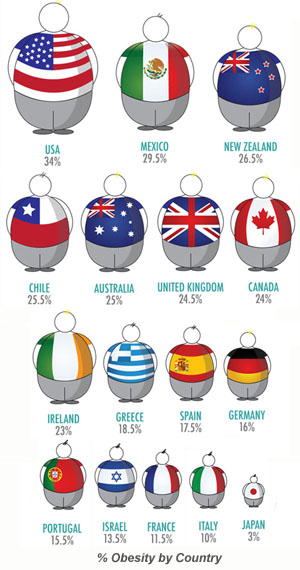
A person is regarded as being obese if they are more than 20 per cent overweight. A healthy BMI stops at 25 and the obese range begins at 30. In Ireland, there are people being treated with BMI's above 50! The average weight per person - we are a couple of stone heavier than we were 30 years ago! This country has over 900,000 people who are obese - resulting in the deaths of nearly 6,000 people each year. The annual cost to the healthcare system - 3 billion euros and counting.

Professor Donal O'Shea is synonymous with the fight against obesity in Ireland and paints a dim picture of where this country is heading, ''Nationally we are losing the battle, we are not reacting to it, either personally or as a society. You only have to look to the States and see where they are, it's not a pretty vista ahead'' (see gif below).
Obesity is now recognised as a ‘global epidemic’ by the World Health Organization (National Taskforce on Obesity, 2005). Along with adults, children are affected by obesity and in Ireland alone it is estimated that 300,000 children are currently overweight or obese (NTO, 2005).

Prof. Donal O'Shea
''It's now unusual to be of normal weight. It's no longer a ticking time bomb - the bomb has exploded - we're at the bomb site'' (O'Shea, 2012).
The epidemic of childhood obesity has been highlighted as a major health concern for today’s youth. It was reported in 2005 that an estimated 20 million children worldwide under the age of 5 were obese (World Health Organisation). The suspected causes of obesity are complex and include environmental and heritable factors (Crothers, 2009), along with lifestyle choices (Centres for Disease Control and Prevention, 2010).
Research also suggests that genetic factors have a role in obesity. With more than 200 genes being linked as possible contributors to obesity, it is highly relevant to look at obesity from a biological point of view. It has been suggested that some people are just predisposed to become overweight, with the heritability of obesity being high (Hinney, 2010), and also the positive correlation between maternal pre-pregnancy obesity influencing early childhood obesity has  been highlighted (Salsberry & Reagan, 2005).

As the obesity number in Ireland nears 1 million, it is clear that we are a country in crisis.

Although research shows that some people with a family history of obesity may be more inclined to gain weight, the recent rapid increase in childhood obesity indicates that lifestyle and not genetic contributions is the primary cause (NTO, 2005).
There's more to life than sitting and eating in front of a television.
 
A lifestyle revolving around the consumption of energy dense foods and a decrease in physical activity creates an environment termed ‘obesogenic’ by the World Health Organization in 1998 (Health Service Executive, 2009). The lifestyle of this environment promotes people to eat too much and exercise too little, creating an energy imbalance which results in weight gain. With a report claiming that children in the United States spend on average 3 hours per day watching television (Committee on Public Communications, 2010), it is possible to see that technological factors could also have a role in promoting an inactive lifestyle. Sedentary behaviours like this are often coupled with eating at the same time (Crothers, 2009). Children spending more time watching television will thus result in less time to engage in physical activities and exercise.
 
The possibility of childhood obesity being determined by Socio Economic Status has been examined as an environmental factor (Stamatakis, 2010). The researchers stated that obesity affects both developed and developing countries alike, but in their study they found that childhood obesity among school children in England had stabilized in recent years, however children from low income households had not benefitted from this trend.

With some of the possible causes being outlined above, what are the health implications for those children affected? The answer is manifold. A result of being overweight can include a lower quality of life (CDC, 2010), an increase in a child’s risk of health problems including; Type-2 diabetes, heart disease, stroke and many types of cancer in later life as well as shortening overall life expectancy (Health Service Executive, 2011).

Regarding obesity in general, Prof. O'Shea remarks, ''With smoking you can point to the heart, point to the lungs, heart attacks, lung cancer and stroke. But with weight related diseases, it's everything; in the brain, your talking about depression, dementia, oesophageal cancer, pancreatic cancer, kidney cancer, heart disease, wear and tear on the hip and knees, right down to your big toe and gout. So everything is made worse by being overweight and it's all remedial''.

You move in a cycle of ups and downs - food adds to the ups and simultaneously creates the downs.
 
Obese children are often the target of stereotypes and discrimination, where being a member of a visibly stigmatised group makes it hard to avoid being prejudiced against. Obesity in childhood not only has health implications but also impacts on the child’s psychological well-being.

Over the last three decades our eating habits have changed dramatically, as the country has been flooded with takeaways, hot deli's and breakfast rolls. If you are any way susceptible to temptation, what hope have you? For many, fast food has become a staple.
 

How America's BMI average has increased ~ CDC
''Parents can't let their children drift the way society is encouraging them to drift'' (O'Shea, 2012). Restrictions on unhealthy food advertising has been suggested as one possible method to prevent children from being influenced by these high calorie foods (Udell & Mehta, 2008), while Carter (2002) suggests a balanced diet consisting of no more than 3 meals per day, fewer high calorie foods and the replacement of sugary drinks like soda, to water.

''Our physical education in schools has failed us . . . it should be focused on health and wellbeing, and sport and activity should only be one part'' (Prof. Niall Moynan, DCU).


'It doesn't matter how slow you go,
you're still lapping everybody on the couch'
Scientific evidence shows that physical activity (PA) helps to maintain a healthy body weight, with people between the ages of 5 to 17 being recommended to accumulate at least 60 minutes of moderate to vigorous intensity PA daily (World Health Organisation, 2011). Physical activity also contributes to the development of healthy bones, muscles and joints, a healthy cardiovascular system and neuromuscular awareness. These benefits demonstrate the role sports and exercise have for overweight children. But common sense also plays a role. Lucozade Sport is great, but to have a five-year-old child drinking 300 calories and only burning off 100 is defeating the purpose entirely.

The further you let yourself go, the longer of a battle it is to get back.
 
Others highlight behavioural changes to help treat obesity (Stewart, Chapple, Hughes, Poustie, & Reilly, 2008). The authors proposed that the use of behavioural change techniques can enhance the motivation of a child by increasing self-awareness of their lifestyle behaviours. Goal setting for changes in diet and physical activity levels, rewards for achieving such goals and the monitoring of diet and low mobile activities (e.g. viewing television), allows the child to monitor progress towards a healthier lifestyle.

''Once you get over a certain weight, people are getting more despairing - you start giving up, nothing is working and they almost give in to the inevitability of more weight gain. There is no magic solution'' (Ruth Yoder - Senior Psychologist at St. Colmcilles Hospital Weight Management Clinic).
 
Parents and caregivers have a responsibility to promote change in their children. They have an immediate impact on shaping their child’s early food environments, attitudes on nutritional information and eating behaviours such as appropriate portion sizes (Anzman, 2010).
 
The global epidemic of childhood obesity is a modern health concern. Research discussed above suggests that childhood obesity is multi-faceted and has numerous and complex variables. One research paper highlighted that some people are possibly just predisposed to be overweight (Hinney, 2010), but with such a rapid increase in those affected by childhood obesity, the lifestyle choices and environmental factors are the more relevant contributors to the problem. People living in a modern day ‘obesogenic’ environment that nurtures weight gain is a considerable problem. Eating too much food, more time spent on sedentary activities, and a lack of health benefitting physical activities like sport, all invariably lead to weight gain. With more unique research proposals on the causes of childhood obesity being related to  socio-economic status, it could be argued that this problem is more than just genetic or diet related.

''At the moment we have a situation where we are sleepwalking into a condition that is killing between 5000 - 6000 people in Ireland every year'' (O'Shea, 2012).
Along with the stigma of carrying excess bodyweight, the health implications of being obese are paramount. In Ireland, 25% of three-year-olds are either overweight or obese. ''The younger you put it on, the bigger you can go'' (O'Shea, 2012). Children should not have to start out life already one step behind in terms of their health.

There are however ways of combatting these problems. By limiting the exposure of certain food advertising (Udell & Mehta, 2008), changing children’s behaviours and cognitions towards their current lifestyle (Stewart, 2008), increasing their time spent with physical activity (WHO, 2011), some simple diet changes (Carter, 2002), and nutritional education from  their primary caregivers (Anzman, 2010), the children and young adults affected by this current epidemic can start to look at its causes as possibly preventable and start to lose weight while adding longevity to their futures.
_____________________________________________________________________________________________________________________

''We're dealing with the kids of 30 years ago, and we're dreading the kids of today in 30 years'' (O'Shea, 2012).