At this stage I think Irish people would be better off evolving gills.
Showing posts with label Ireland. Show all posts
Showing posts with label Ireland. Show all posts
Saturday, December 07, 2024

Monday, June 05, 2023
''Begin'' - from The Essential Brendan Kennelly.
Brendan Kennelly recited this poem at the end of an episode of The Late Late Show in 1997. During the episode, Gay Byrne spoke with a recently bereaved mother who was chosen at random from among hundreds of thousands of entries for a postal quiz. The caller's daughter had sadly passed away due to a road accident the night before. It was a unique moment in the history of Irish television. Brendan's recital of the poem at the end of the show just fit perfectly in to the indescribable tragedy of it all.
Begin again to the summoning birds
to the sight of the light at the window,
begin to the roar of morning traffic
all along Pembroke Road.
Every beginning is a promise
born in light and dying in dark
determination and exaltation of springtime
flowering the way to work.
Begin to the pageant of queuing girls
the arrogant loneliness of swans in the canal
bridges linking the past and future
old friends passing though with us still.
Begin to the loneliness that cannot end
since it perhaps is what makes us begin,
begin to wonder at unknown faces
at crying birds in the sudden rain
at branches stark in the willing sunlight
at seagulls foraging for bread
at couples sharing a sunny secret
alone together while making good.
Though we live in a world that dreams of ending
that always seems about to give in
something that will not acknowledge conclusion
insists that we forever begin.
Begin again to the summoning birds
to the sight of the light at the window,
begin to the roar of morning traffic
all along Pembroke Road.
Every beginning is a promise
born in light and dying in dark
determination and exaltation of springtime
flowering the way to work.
Begin to the pageant of queuing girls
the arrogant loneliness of swans in the canal
bridges linking the past and future
old friends passing though with us still.
Begin to the loneliness that cannot end
since it perhaps is what makes us begin,
begin to wonder at unknown faces
at crying birds in the sudden rain
at branches stark in the willing sunlight
at seagulls foraging for bread
at couples sharing a sunny secret
alone together while making good.
Though we live in a world that dreams of ending
that always seems about to give in
something that will not acknowledge conclusion
insists that we forever begin.
Monday, January 18, 2021
Well-being is based on mental maintenance

Seeking support is not a weakness, it’s a necessity. Reach out. Get professional help. For some people, going through a difficult time in life will not require professional help, however for some, a qualified and experienced ear can be hugely beneficial when it comes to finding your way in this new world. It’s about processing your emotions around the situation and learning ways to navigate the tough times that are emotionally helpful.
~ Fitzpatrick, PSI, 2018
Sunday, November 08, 2020
Biden on the Horizon
''With our gift for language and willingness to stand up and be counted, as well as heaps of charm and charisma, we Irish have long been an integral part of American political life''

~ Rashers Tierney
F*ck You, I'm Irish: Why We Irish Are Awesome
Wednesday, October 07, 2020
Cross Border Directive
The Cross Border Directive (CBD) allows you to get healthcare in another EU or EEA member state. You can access this healthcare in the same way you'd get public healthcare in Ireland. The healthcare must be planned, you need a valid referral, and you must qualify for the healthcare you want as a public patient in Ireland. Once you go abroad, you must pay for any healthcare that you get. But under the CBD you can then apply to the HSE for reimbursement towards the cost of the healthcare. You can not claim reimbursement for: the cost of any medicine you'll need afterwards or any travel costs. You can access healthcare abroad using the Cross Border Directive (CBD) in much the same way that you would access public healthcare in Ireland.
How you usually get public healthcare in Ireland
The typical steps you would take when getting healthcare or treatment in a public hospital in Ireland are:
1. Visit your GP to discuss your condition.
2. Your GP refers you to a hospital consultant.
3. You are put on a hospital waiting list to see the consultant.
4. You get called for a consultation with the consultant - this is called an outpatient appointment.
5. The consultant will decide to either to put you on a waiting list for treatment, or discharge you back to your GP - this means they don’t believe you need further hospital treatment.
6. If you are on a waiting list for treatment, you will be called for hospital treatment - this is called inpatient treatment.
7. You will then have a follow up appointment with the consultant.
8. You will then be discharged back to your GP.
At any stage in the steps outlined above, you can decide to leave the Irish system and get healthcare abroad under the CBD.
To get healthcare abroad and be refunded under the Cross Border Directive (CBD) you must:
Be ordinarily resident in Ireland (Ordinarily resident means that you've been living in Ireland for at least one year or can prove your intention to remain in Ireland for at least one year). Be entitled to public healthcare in Ireland Not be in receipt of any state benefit from another EU or EEA member state Travel abroad for the healthcare Have a referral for public healthcare from a GP or hospital consultant in Ireland Provide a copy of a letter of referral or a letter from a hospital to say you're on a waiting list in Ireland Apply for repayment towards the cost of your healthcare abroad, after you have paid for it Only a GP or a consultant you are attending as a public patient can refer you for CBD healthcare. Having private health insurance does not exclude you from CBD. But you cannot use your private health insurance to access your referral for healthcare abroad. You can use a referral for public healthcare in Ireland to access healthcare abroad under the CBD. You don’t need to be referred specifically to a healthcare provider abroad. If your referral is to a public hospital in Ireland you can also use that referral to go abroad. But your healthcare abroad must be the same medical specialty you've been referred to in Ireland. This referral usually comes from a GP or hospital consultant. You'll see your GP first and discuss your condition. They will then decide if you need a referral to a hospital consultant or if they can manage your condition. Once you go abroad, you must pay for any healthcare that you get. But under the CBD you can then apply to the HSE to claim repayment towards the cost of the healthcare once you meet certain conditions. If you meet these conditions and your application is successful, you will be reimbursed whichever is the lesser: the cost of your healthcare abroad, or what the healthcare would have cost in Ireland
Types of healthcare available
There is no list of specific healthcare you can get abroad under Cross Border Directive (CBD) scheme. Generally, if the healthcare is available publicly in Ireland, you can be referred for the same healthcare abroad. Your GP or consultant can tell you if the healthcare you want to get abroad is publicly available in Ireland and if you qualify for it.
Healthcare available under CBD
Examples of healthcare available under the CBD scheme: day, inpatient and outpatient care in acute hospital services, including psychiatric services, community-based outpatient care, dental and orthodontic services (with some exceptions, such as dental screening services in schools), speech and language services, occupational therapy services (with some exceptions, such as assessment for aids at home), psychology services, physiotherapy services, disability services, ophthalmic (eyes, cataracts) services, orthopaedic (hip replacements) services, mental health services, methadone programme.
Healthcare not available under CBD
Examples of healthcare you can’t get under the CBD include: organ transplants, any long-term care that helps people do everyday tasks such as nursing home care, vaccination against infectious diseases, clinical trials, drug therapies that aren't currently provided publicly in Ireland.
Full information outlining the Cross Border Directive (CBD) can be found on the following HSE website: https://www2.hse.ie/services/cross-border-directive/about-the-cross-border-directive.html
Thursday, March 05, 2020
Economic Considerations of Obesity
Approximately 80% of GP consultations and 60% of hospital bed days are related to chronic illness and their complications, many of which are caused by, or exacerbated by, overweight and obesity. Bariatric surgery, considered the last management option for the morbidly obese, is estimated to cost approximately €30,200 per gastric bypass procedure and €20-€22,000 for gastric banding.

No disease that can be treated by diet should be treated with any other means ~ Maimonides.

No disease that can be treated by diet should be treated with any other means ~ Maimonides.
Sunday, February 10, 2019
2018, In the Blink of an Eye
It was the Busta Rhymes, It was the Wursta Rhymes.
From the Ordinary to the Extraordinary.
2 interviews and 4 brake shoes,
Researching and breakthroughs.
New gins, old gins. New friends, old friends.
Relationships, Friendships, Hardships.
Auschwitz tours and Cards against Humanity,
Graphing data while losing my Sanity.
From breakfasts at the Junction, and bloody Coppers tryna function.
Yanny or Laurel, and every minor quarrel,
The piss-ups in Enniscorthy; bordering on the immoral.
Out fine dining or just eating Chickens,
Netflix and chill - scratching my Charles Dickens.
McGregor, Mourinho, and Kim Jong Un,
Causeways and Salt Mines and the Pope in Ballymun.
A little off the top, 20 on number seven,
BT, T.M.Lewin; feck the recession.
A year of kind and special acts,
And the scumbags, maggots, and cheap lousy [redacts].
From flossing to yodelling, to surgery on a grape,
I'm eating too many selection boxes, to maintain this shape.
A gazillion birthdays, 3 weddings and the christening.
Bustin' my balls in spontaneous River Dancin'.
Doctors checking, and dentists pulling,
Bar staff pouring...and me skulling.
Drinking-boozing, messy nights of fun.
Shots and beer, and Christ the fear.
Repealing the 8th, "It's Coming Home".
Donald Trump, and a Game of Thrones.
Over-worked and underlaid,
Wondering next when I'll get paid.
The M50 and swearing, but air travel's fine,
Albeit, I'm preloaded on wine.
Upload, download, liking and scrolling,
Ticking off bucket lists and scenes in Poland.
Jameson tours and the 90 foot of snow,
Hen parties, music; and the boats and hoes.
Stairways to Heaven and selfies from hell.
Hello to new employers, and to others farewell.
Overindulgence and moderation,
Peter Casey and a polling station.
Studying-advising, musing-procrastinating.
Always buying, more than saving.
To jumping in, and my comfort zones,
To the Lynx showers and the new colognes.
Bills, NCTs and Penalty Points.
Inbox checking, PowerPoints.
Wandering Northside, Southside, Countryside,
Wondering if I'll ever be Board Certified.
Presidential hopefuls and Michael D.
To too much thinking WITH my D.
And the working hard or hardly working,
The Titanic, volunteering, and all the flirting.
From reading comments in the Journal,
To overcoming societal hurdles.
Alarms, snooze; being lazy,
To newborn nieces...'Sup Baby!
Crossing a rope bridge in Northern tranquillity,
To working with disability, and wanting stability.
RIP Dolores and a Queen of Soul,
Royal Weddings, Backstops, and Brexit me hole!
Sober analysis and common sense,
Or being indecisive and sitting on the fence.
Laminating, researching, systematic-reviewing.
Gym and sweating, or sitting and regretting.
Dressing up, grooming and shaving,
Dating - Mating - Masturbating.
To being an ass, and a misplaced boarding pass,
To the comedy and laughs, that ye can't say at Mass.
The West of Ireland, Beasts from the East,
Afternoon tea in the sunny South East.
Happiness, sadness, pain and stress,
Sports and dog-walking...cleaning up his mess.
The whole shebang, and travels to London,
Crying-fighting-apologising...loving.
John Lewis and a cross city Luas; watering cans - hose pipe bans.
Bad weather, good weather - now and then.
That summer for 3 months, can we have it again?
Haps to the Baps, and VB-MAPPs;
Chicken wraps and hungover Macs.
Confirmations and celebrations,
Heuston station, agencies relocating.
Eating-munching, and trying not to choke,
Cleaning, scrubbing...leave the big pan to soak.
All the self-talk and the feeling well,
To the sneaky self-doubt...FML.
Hear me now, and hear me well,
It'll probably get worse before it gets well.
Every faux pas, and every blooper,
Fearing change, yet embracing the future.
To every yes, and every no,
From pillar to post, to the status quo.
So 2019, no quiet ones then,
In the words of a Pint-Man, "I'll go at it again".
From the Ordinary to the Extraordinary.
2 interviews and 4 brake shoes,
Researching and breakthroughs.
New gins, old gins. New friends, old friends.
Relationships, Friendships, Hardships.
Auschwitz tours and Cards against Humanity,
Graphing data while losing my Sanity.
From breakfasts at the Junction, and bloody Coppers tryna function.
Yanny or Laurel, and every minor quarrel,
The piss-ups in Enniscorthy; bordering on the immoral.
Out fine dining or just eating Chickens,
Netflix and chill - scratching my Charles Dickens.
McGregor, Mourinho, and Kim Jong Un,
Causeways and Salt Mines and the Pope in Ballymun.
A little off the top, 20 on number seven,
BT, T.M.Lewin; feck the recession.
A year of kind and special acts,
And the scumbags, maggots, and cheap lousy [redacts].
From flossing to yodelling, to surgery on a grape,
I'm eating too many selection boxes, to maintain this shape.
A gazillion birthdays, 3 weddings and the christening.
Bustin' my balls in spontaneous River Dancin'.
Doctors checking, and dentists pulling,
Bar staff pouring...and me skulling.
Drinking-boozing, messy nights of fun.
Shots and beer, and Christ the fear.
Repealing the 8th, "It's Coming Home".
Donald Trump, and a Game of Thrones.
Over-worked and underlaid,
Wondering next when I'll get paid.
The M50 and swearing, but air travel's fine,
Albeit, I'm preloaded on wine.
Upload, download, liking and scrolling,
Ticking off bucket lists and scenes in Poland.
Jameson tours and the 90 foot of snow,
Hen parties, music; and the boats and hoes.
Stairways to Heaven and selfies from hell.
Hello to new employers, and to others farewell.
Overindulgence and moderation,
Peter Casey and a polling station.
Studying-advising, musing-procrastinating.
Always buying, more than saving.
To jumping in, and my comfort zones,
To the Lynx showers and the new colognes.
Bills, NCTs and Penalty Points.
Inbox checking, PowerPoints.
Wandering Northside, Southside, Countryside,
Wondering if I'll ever be Board Certified.
Presidential hopefuls and Michael D.
To too much thinking WITH my D.
And the working hard or hardly working,
The Titanic, volunteering, and all the flirting.
From reading comments in the Journal,
To overcoming societal hurdles.
Alarms, snooze; being lazy,
To newborn nieces...'Sup Baby!
Crossing a rope bridge in Northern tranquillity,
To working with disability, and wanting stability.
RIP Dolores and a Queen of Soul,
Royal Weddings, Backstops, and Brexit me hole!
Sober analysis and common sense,
Or being indecisive and sitting on the fence.
Laminating, researching, systematic-reviewing.
Gym and sweating, or sitting and regretting.
Dressing up, grooming and shaving,
Dating - Mating - Masturbating.
To being an ass, and a misplaced boarding pass,
To the comedy and laughs, that ye can't say at Mass.
The West of Ireland, Beasts from the East,
Afternoon tea in the sunny South East.
Happiness, sadness, pain and stress,
Sports and dog-walking...cleaning up his mess.
The whole shebang, and travels to London,
Crying-fighting-apologising...loving.
John Lewis and a cross city Luas; watering cans - hose pipe bans.
Bad weather, good weather - now and then.
That summer for 3 months, can we have it again?
Haps to the Baps, and VB-MAPPs;
Chicken wraps and hungover Macs.
Confirmations and celebrations,
Heuston station, agencies relocating.
Eating-munching, and trying not to choke,
Cleaning, scrubbing...leave the big pan to soak.
All the self-talk and the feeling well,
To the sneaky self-doubt...FML.
Hear me now, and hear me well,
It'll probably get worse before it gets well.
Every faux pas, and every blooper,
Fearing change, yet embracing the future.
To every yes, and every no,
From pillar to post, to the status quo.
So 2019, no quiet ones then,
In the words of a Pint-Man, "I'll go at it again".
Tuesday, October 02, 2018
Political jokes...get elected.

Money and corruption are ruining the land, crooked politicians betray the working man, pocketing the profits and treating us like sheep, and we're tired of hearing promises that we know they'll never keep ~ Ray Davies
Sunday, July 03, 2016
Farming in rural Ireland
In Ireland it is common for rates of depression to be highly prevalent in rural areas of the country. One population that are vulnerable are men, particularly farmers who may spend much of their time in isolation tending to their lands and livestock. A tough job to be involved in especially considering the long hours involving little human interaction.
Many middle-age men living in rural Ireland who spend the majority of their time farming may often have inherited the farm from their parents. Consequently, they may never have got married due to the amount of time they had to invest in the duties of farming life. Although no one is too old to find a partner, bachelors like these may feel that their time has passed and that there is little chance or time to pursue meeting someone.
The 'pickings' may be slimmer if a farmers only dealings with other people are other local farmers, employees in cattle marts and creameries, or vets making visits to the farm to check on animals and so forth. So much so has this combination of depression and isolation been recognised that some veterinarians are even being trained to spot the signs of depression in people they deal with.
It's an extremely relevant issue in Ireland today and has been for a long time. The topic was recently examined in a 2013 film called Pilgrim Hill . It depicts the life of an Irish cattle farmer, living alone with his invalided father in a remote Irish location.
I'd highly recommend a viewing. It captures the forgotten side of rural Ireland and the tragic sense of what is often involved for some men working in the Irish farming industry today.

______________________________________________________________________________________________________________________
The Irish Times (in a four-star review): "Barrett's debut feature is a quietly stunning slice of rural naturalism. A masterful debut."
Friday, May 20, 2016
Applied Behaviour Analysis
Applied Behaviour Analysis (ABA) is an effective behavioural treatment programme widely used with children with autism to improve socially significant behaviours.

ABA makes meaningful changes in people's lives through the use of procedures that have been demonstrated to work. The goal of an ABA teaching environment is to build socially significant behaviours in a meaningful way and to a meaningful degree. Generalisation, spontaneity and fun are essential components of successful intervention.
 A few years ago, Ireland was in the fortunate position of having 12 ABA schools that had been set up and staffed in a way that made possible comprehensive programmes for children with autism (Leslie, 2013). However, the changes implemented from 2010 mean this is far from being the case now. Members of the Division of Behaviour Analysis are either in or in close touch with these schools. They are now termed special schools and, because of the rules they operate under none of them can meet the specifications for an ABA school.
 ABA aspires to help with serious behavioural problems. A serious behavioural problem is one that impairs the quality of life of the person to a significant degree, impacts negatively on the lives of others, is persistent (thus rarely goes away of its own accord), and is not readily removed by some simple or brief treatment or intervention.
Some of the problems of many children with autism meet these criteria. If help is not provided or not adequate, their behavioural problems may leave them trailing far behind their peers of the same age in personal, social and educational development.
For more information see the following links:
______________________________________________________________________
''If they can't learn the way we teach, we teach the way they learn'' ~ O. Ivar Lovaas
Friday, August 01, 2014
Warning Signs for Suicide
The best predictor of suicide attempts in both women and men is a verbal or behavioural threat to commit suicide, and such threats should always be taken seriously.
 One of the most destructive myths about suicide is that people who talk openly about suicide are just seeking attention and do not actually intend to carry out the act. Yet research shows that a high proportion of suicide attempts - perhaps 80 percent - are preceded by some kind of warning (Bagley & Ramsay, 1997). Sometimes the warning is an explicit statement of intent, such as 'I don't want to go on living' or 'I won't be around for much longer'. Other times, the warnings are more subtle, as when a person expresses hopelessness about the future, withdraws from others or from favourite activities, gives away treasured possessions, or takes unusual risks.
Other important risk factors are a history of previous suicide attempts and a detailed plan that involves a lethal method (Chiles & Strossahl, 1995; Shneidman, 1998). Substance abuse also increases suicide risk (Yen et al., 2003; Passer & Smith, 2009).
There's an enormous amount of pain in the world. Not physical pain but psychological pain. It's an ache in the mind. It's an ache of the negative emotions. It's the ache of guilt and of shame, and of loneliness and rejection. It comes from thwarted, blocked, frustrated, trampled upon psychological needs. And if I were to commit suicide, it would be in terms of my frustrated needs. And if you were my therapist, I would be grateful if you understood me, not in terms of my biology or my parents or my psychodynamics, but in terms of what needs were bugging me.
______________________________________________________________________________________________________________________''The grief of the worshippers left behind, the awful famine in their hearts, these are too costly terms for the release''
~ Mark Twain
Samaritans Pieta House Turn2Me
Ireland: 1850 60 90 90 Website: www.pieta.ie Website: www.turn2me.org
Wednesday, June 11, 2014
Suicide and Ireland
Figures from the Central Statistics Office show that the number of suicides registered in Ireland fell by 6% last year. The CSO's yearly summary shows 475 suicides were registered in 2013, compared to 507 in 2012. The CSO statistics show several counties recording rates of suicide well above the national average of 10.3 per 100,000 population. Males accounted for over 83% of all suicide deaths last year. The number of registered suicides in the 15-24 age group fell by 23% last year, however Ireland still has the fourth highest suicide rate in that age group in the European Union (RTE, 2014).
Women are likely to attempt suicide about three times more often than men, but men are, on average, three times more likely to actually kill themselves. These differences may be due to (1) a higher incidence of depression in women and (2) men's choice of more violent and lethal methods, such as shooting themselves or jumping off buildings. The suicide rate for both men and women is higher among those who have been divorced or widowed. Women's suicides are more likely to be triggered, although not certain to be triggered by any means, by failures in love relationships, whereas career failure more often prompts men's suicides (Shneidman, 1976). Further, a history of sexual or physical abuse significantly increases the likelihood of later suicide attempts (Garnefski & Arends, 1998).
Is suicide contagious?
 Most people react to hearing the news of a suicide with sadness and curiosity. Some people react by attempting suicide themselves, often by the same method they have just heard about. Gould (1990) reported an increase in suicides during a 9-day period after widespread publicity about a suicide. Clusters of suicides (several people copying one person) seem to predominate among teenagers, with as many as 5% of all teenage suicides reflecting an imitation (Gould, 1990; Gould, Greenberg, Velting, & Shaffer, 2003). Suicide prevention charity Console has called for a real-time register of suicide data to be kept. It said it could then "act on timely and accurate statistics to put measures in place to prevent such phenomena as suicide clustering or contagion".
Why would anyone want to copy a suicide? First, suicides are often romanticized in the media: An attractive young person under unbearable pressure commits suicide and becomes a martyr to friends and peers by getting even with the (adult) world for creating such a difficult situation. Also, media accounts often describe in detail the methods used in the suicide, thereby providing a guide to potential victims. Little is reported about the paralysis, brain damage, and other tragic consequences of the incomplete or failed suicide or about how suicide is almost always associated with a severe psychological disorder. More important, even less is said about the futility of this method of solving problems (Gould, 1990, 2001; O’Carroll, 1990).
To prevent these tragedies, mental health professionals must intervene immediately in schools and other locations with people who might be depressed or otherwise vulnerable to the contagion of suicide. But it isn’t clear that suicide is ''contagious'' in the infectious disease sense. Rather, the stress of a friend’s suicide or some other major stress may affect several individuals who are vulnerable because of existing psychological disorders (Durand & Barlow, 2013).
_____________________________________________________________________________________________________________________
Women are likely to attempt suicide about three times more often than men, but men are, on average, three times more likely to actually kill themselves. These differences may be due to (1) a higher incidence of depression in women and (2) men's choice of more violent and lethal methods, such as shooting themselves or jumping off buildings. The suicide rate for both men and women is higher among those who have been divorced or widowed. Women's suicides are more likely to be triggered, although not certain to be triggered by any means, by failures in love relationships, whereas career failure more often prompts men's suicides (Shneidman, 1976). Further, a history of sexual or physical abuse significantly increases the likelihood of later suicide attempts (Garnefski & Arends, 1998).
Is suicide contagious?
Most people react to hearing the news of a suicide with sadness and curiosity. Some people react by attempting suicide themselves, often by the same method they have just heard about. Gould (1990) reported an increase in suicides during a 9-day period after widespread publicity about a suicide. Clusters of suicides (several people copying one person) seem to predominate among teenagers, with as many as 5% of all teenage suicides reflecting an imitation (Gould, 1990; Gould, Greenberg, Velting, & Shaffer, 2003). Suicide prevention charity Console has called for a real-time register of suicide data to be kept. It said it could then "act on timely and accurate statistics to put measures in place to prevent such phenomena as suicide clustering or contagion".Why would anyone want to copy a suicide? First, suicides are often romanticized in the media: An attractive young person under unbearable pressure commits suicide and becomes a martyr to friends and peers by getting even with the (adult) world for creating such a difficult situation. Also, media accounts often describe in detail the methods used in the suicide, thereby providing a guide to potential victims. Little is reported about the paralysis, brain damage, and other tragic consequences of the incomplete or failed suicide or about how suicide is almost always associated with a severe psychological disorder. More important, even less is said about the futility of this method of solving problems (Gould, 1990, 2001; O’Carroll, 1990).
To prevent these tragedies, mental health professionals must intervene immediately in schools and other locations with people who might be depressed or otherwise vulnerable to the contagion of suicide. But it isn’t clear that suicide is ''contagious'' in the infectious disease sense. Rather, the stress of a friend’s suicide or some other major stress may affect several individuals who are vulnerable because of existing psychological disorders (Durand & Barlow, 2013).
_____________________________________________________________________________________________________________________
''The ability to be in the present moment is a major component of mental wellness'' ~ Abraham Maslow
Friday, October 18, 2013
Stigma - A major barrier to Suicide Prevention
According to the WHO and the latest Burden of Disease Estimation, suicide is a major public health problem in high income countries and is an emerging problem in low and middle income countries. Suicide is one of the leading causes of death in the world, especially among young people.
Nearly one million people worldwide die by suicide each year. This corresponds to one death by suicide every 40 seconds. The number of lives lost each year through suicide exceeds the number of deaths due to homicide and war combined. These staggering figures do not include nonfatal suicide attempts which occur much more frequently than deaths by suicide.
Suicides in Republic of Ireland from 2001-2013
 2001 - 519
2002 - 478
2003 - 497
2004 - 493
2005 - 481
2006 - 460
2007 - 458
2008 - 506
2009 - 552
2010 - 490
2011 - 525
2012 - 507
Suicides in Republic of Ireland from 2001-2013
 2001 - 519
2002 - 478
2003 - 497
2004 - 493
2005 - 481
2006 - 460
2007 - 458
2008 - 506
2009 - 552
2010 - 490
2011 - 525
2012 - 507
*2013 - 475 (6% drop, with males accounting for over 83% of all suicide deaths last year.)
A large proportion of people who die by suicide suffer mental illness. Recent estimates suggest that the disease burden caused by mental illnesses will amount for 25% of the total disease burden in the world in the next two decades, making it the most important category of ill-health (more important than cancer or heart diseases.)
A significant number of those with mental illnesses who die by suicide do not contact health or social services near the time of their death. In many instances, there are insufficient services available to assist those in need at times of crisis. Lack of access to appropriate care is one of the many factors that magnify the stigma associated with mental illness and with suicidal ideation and behaviour. This type of stigma, which is deeply rooted in most societies, can arise for different reasons.
For some people, the term 'suicide' alone evokes panic and one of the causes of stigma is a simple lack of knowledge - that is, ignorance. This type of stigma can be directly addressed by providing a range of community-based educational programs that are targeted to specific subgroups within the society (that is, by age, educational level, religious affiliation, and so forth). Negative attitudes about individuals with mental illnesses and/or suicidal ideation or impulses (prejudice) is common in many communities. These negative attitudes often do not change with education about mental illnesses and suicidal behaviour.
Many health professionals who feel uncomfortable dealing with persons struggling with mental illnesses or suicidal ideation often hold negative, prejudicial attitudes towards such patients. This can result in a failure to provide optimal care and support for persons in crisis.
Stigma is also the underlying motive for discrimination - inappropriate or unlawful restrictions of the freedom of individuals with mental illnesses or suicidal behaviour. Such restrictions can occur at a personal, community or institutional level. One extreme example is the criminalization of suicidal behaviour, which still occurs in many countries. Discrimination can prevent or discourage people affected by mental illness and/or suicidal ideation or behaviour from seeking professional help, or from returning to their normal social roles, after receiving treatment for an episode of illness or crisis.
In both high-income and low and middle-income countries stigmatized conditions such as mental illnesses and suicidal behaviour receive a much smaller proportion of health and welfare budgets than is appropriate, given their huge impact on the overall health of the community.
Unless the stigma is confronted and challenged, it will continue to be a major barrier to the treatment of mental illnesses and to the prevention of suicide. Events like World Mental Health Day (October 10th) and World Suicide Prevention Day (September 10th) are ideal times to highlight and inspire people to work towards the goal of developing creative new methods for eradicating stigma and helping to save lives.
_____________________________________________________________________________
Each morning when you open your eyes, say to yourself: “I, not external people or events, have the power to make me happy or unhappy today. It’s up to me. Yesterday is gone and tomorrow hasn’t come yet. I only have today and I’m going to be happy in it.”
_____________________________________________________________________________
Each morning when you open your eyes, say to yourself: “I, not external people or events, have the power to make me happy or unhappy today. It’s up to me. Yesterday is gone and tomorrow hasn’t come yet. I only have today and I’m going to be happy in it.”
Friday, September 06, 2013
Mirror Mirror on the Wall...
An early test of self-recognition and awareness of oneself is the rouge test. Performed in front of a mirror, a child would have a spot of rouge make-up surreptitiously placed on their forehead and the reactions based on the child's response to the mirror image would be assessed. It is successfully accomplished by most children by the age of 18 months. And by god, once we did spot who was in the mirror looking out at us - we couldn't get enough it seems.
 |
| Rouge Test at 17.5 months |
From clothes shops, shoe shops, sunglasses shops, and a bookies amongst others, some recent places that I have come into contact with this obvious necessity of a fixture include;
Starbucks! I'm looking at myself as I ordered a Starbucks the other day. Scruffy, half asleep and surrounded by coffee slurping smugatude...no escape!
In a TV store. I catch a glimpse of myself while I ponder which big electric b**tard to buy. While beside me kids jump about in front of an EIGHT FOOT MIRROR sporting 3D glasses, screaming at their parents who look at one other with an undertone of hatred in their eyes, ''Why God, Why us?''
A bank! I mean what the fook? Yes, this is what it looks like to be broke. Haha, no they don't take bank bags full of buttons! ''Hey, I'm financially set for life as long as I die next Tuesday, you reflective son of a ...!''
 |
| @DoucheBag said, ''Ride-by Selfie...lol'' |
A bank! I mean what the fook? Yes, this is what it looks like to be broke. Haha, no they don't take bank bags full of buttons! ''Hey, I'm financially set for life as long as I die next Tuesday, you reflective son of a ...!''
I mean mirrors in phone shops? ''Yes, I think that this phone adequately portrays me as a bell-end, I'll take it''...just before you take a quick selfie and post it on Twitter along with some hoot of a line...Oh the hilarity.
In a deli shop! Right beside where you can heat up those heart-attack inducing lumps of dirt, while viewing the look of shame on your face as the microwave pings...and proceeding with a rubberneckers view of your own probable ''Oohh-face'' as scalding hot slop rolls from your chin.
 |
| Discount Tuesdays: for those with room temperature I.Q's |
Or petrol stations? Just in case you inadvertently go up in a ball of flames, well then at least you can have a front row view to your own smouldering crispy finale. ''20 on number 7 and some after-sun please''.
Years ago my grandmother used to come in from a night out and the first thing she would do is check how she looked in the mirror. Or I guess how she looked all those previous hours. I mean she was a great woman and everything, but sure by that stage there was no real point on fixing a stray hair. But nonetheless she did it and surprisingly not once was she presented with a 'There's Something about Mary' scenario.
 |
| 'Please leave the hotel room as you would like to find it' Merle began first on tackling that unnecessary partition wall |
Obviously we have the other side of the coin as with everything. Mirrors make a room feel more spacious...and all that Feng shui nonsense. Places such as barbers, fair enough, you're gonna have to wear this 10 euro haircut for the next few weeks...best to have a look at the butchery as it unfolds. Mirror shops, I suppose. Gyms, to inflate ego's or deflate self esteem, either-or.
Maybe some people just got one too many ''Kick Me's'' posted on their back and you know, they have to check themselves every so often.
And then there's the addition of the 'Black mirrors'. Those omnipresent gadgets that allow you to view yourself on a continual basis; the screens of gadgets, TVs, mobile phones, computers through which we interact with the world. But that's for another days ramblings.
Jacques Lacan's Mirror Stage (1936) was described as a founding act that lead to the formation of the ego and the perception of the Subject. The baby's discovery of self is an intellectual act that involves the translation of an image into an idea - the idea of 'Me' or 'Self', or is it 'Selfie'?
Either way, it seems that in present times the "méconnaissance'' of the subject is truly no longer a concern.
__________________________________________________________________________
Maybe some people just got one too many ''Kick Me's'' posted on their back and you know, they have to check themselves every so often.
 |
| Le Moi. Now available in 42" |
And then there's the addition of the 'Black mirrors'. Those omnipresent gadgets that allow you to view yourself on a continual basis; the screens of gadgets, TVs, mobile phones, computers through which we interact with the world. But that's for another days ramblings.
Jacques Lacan's Mirror Stage (1936) was described as a founding act that lead to the formation of the ego and the perception of the Subject. The baby's discovery of self is an intellectual act that involves the translation of an image into an idea - the idea of 'Me' or 'Self', or is it 'Selfie'?
Either way, it seems that in present times the "méconnaissance'' of the subject is truly no longer a concern.
__________________________________________________________________________
''Let us be grateful to the mirror for revealing to us our appearance only''
~ Samuel Butler
~ Samuel Butler
Saturday, May 04, 2013
The Crisis Point of Obesity - With Notable Attention on Childhood
A person is regarded as being obese if
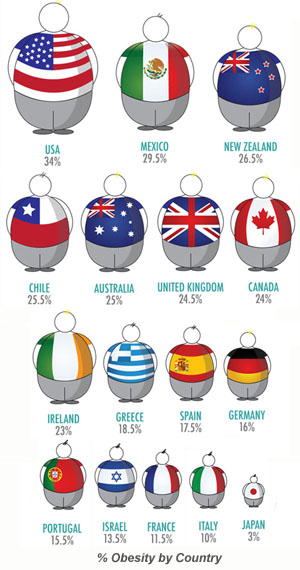
they are more than 20 per cent overweight. A healthy BMI stops at 25 and the obese range begins at 30. In Ireland, there are people being treated with BMI's above 50! The average weight per person - we are a couple of stone heavier than we were 30 years ago! This country has over 900,000 people who are obese - resulting in the deaths of nearly 6,000 people each year. The annual cost to the healthcare system - 3 billion euros and counting.
 Professor Donal O'Shea is synonymous with the fight against obesity in Ireland and paints a dim picture of where this country is heading, ''Nationally we are losing the battle, we are not reacting to it, either personally or as a society. You only have to look to the States and see where they are, it's not a pretty vista ahead'' (see gif below).

Obesity is
now recognised as a ‘global epidemic’ by the World Health Organization
(National Taskforce on Obesity, 2005). Along with adults, children are affected by obesity and in Ireland alone it is estimated that
300,000 children are currently overweight or obese (NTO, 2005).
''It's now unusual to be of normal weight. It's no longer a ticking time bomb - the bomb has exploded - we're at the bomb site'' (O'Shea, 2012).
 |
| Prof. Donal O'Shea |
The
epidemic of childhood obesity has been highlighted as a major health concern
for today’s youth. It was reported in 2005 that an estimated 20 million
children worldwide under the age of 5 were obese (World Health Organisation). The suspected causes of obesity are
complex and include environmental and heritable factors (Crothers, 2009), along with lifestyle choices (Centres for
Disease Control and Prevention, 2010).
Research
also suggests that genetic factors have a role in obesity. With more than
200 genes being linked as possible contributors to obesity, it is highly relevant
to look at obesity from a biological point of view. It has been suggested that some people are just predisposed to become
overweight, with the heritability of obesity being high (Hinney, 2010), and also the positive correlation between maternal
pre-pregnancy obesity influencing early childhood obesity has been highlighted (Salsberry & Reagan,
2005).
As the obesity number in Ireland nears 1 million, it is clear that we are a country in crisis.
Although research shows that some people with a family history of obesity may be more inclined to gain weight, the recent rapid increase in childhood obesity indicates that lifestyle and not genetic contributions is the primary cause (NTO, 2005).
As the obesity number in Ireland nears 1 million, it is clear that we are a country in crisis.
Although research shows that some people with a family history of obesity may be more inclined to gain weight, the recent rapid increase in childhood obesity indicates that lifestyle and not genetic contributions is the primary cause (NTO, 2005).
There's more to life than sitting and eating in front of a television.
A lifestyle
revolving around the consumption of energy dense foods and a decrease in
physical activity creates an environment termed ‘obesogenic’ by the World
Health Organization in 1998 (Health Service Executive, 2009). The
lifestyle of this environment promotes people to eat too much and exercise
too little, creating an energy imbalance which results in weight gain. With a report
claiming that children in the United States spend on average 3 hours per day
watching television (Committee on Public Communications, 2010), it is possible to see that technological factors
could also have a role in promoting an inactive lifestyle. Sedentary behaviours
like this are often coupled with eating at the same time (Crothers, 2009). Children spending more time watching
television will thus result in less time to engage in physical activities
and exercise.
The possibility
of childhood obesity being determined by Socio Economic Status has been
examined as an environmental factor (Stamatakis, 2010). The
researchers stated that obesity affects both developed and developing countries
alike, but in their study they found that
childhood obesity among school children in England had stabilized in recent
years, however children from low income households had not benefitted from this
trend.
With some of the possible causes being outlined above, what are the health implications for those children affected? The answer is manifold. A result of being overweight can include a lower quality of life (CDC, 2010), an increase in a child’s risk of health problems including; Type-2 diabetes, heart disease, stroke and many types of cancer in later life as well as shortening overall life expectancy (Health Service Executive, 2011).
 Regarding obesity in general, Prof. O'Shea remarks, ''With smoking you can point to the heart, point to the lungs, heart attacks, lung cancer and stroke. But with weight related diseases, it's everything; in the brain, your talking about depression, dementia, oesophageal cancer, pancreatic cancer, kidney cancer, heart disease, wear and tear on the hip and knees, right down to your big toe and gout. So everything is made worse by being overweight and it's all remedial''.
With some of the possible causes being outlined above, what are the health implications for those children affected? The answer is manifold. A result of being overweight can include a lower quality of life (CDC, 2010), an increase in a child’s risk of health problems including; Type-2 diabetes, heart disease, stroke and many types of cancer in later life as well as shortening overall life expectancy (Health Service Executive, 2011).

You move in a cycle of ups and downs - food adds to the ups and simultaneously creates the downs.
Obese children
are often the target of stereotypes and discrimination, where being a member of a
visibly stigmatised group makes it hard to avoid being prejudiced against. Obesity in childhood not only has health implications but
also impacts on the child’s psychological well-being.
Over the last three decades our eating habits have changed dramatically, as the country has been flooded with takeaways, hot deli's and breakfast rolls. If you are any way susceptible to temptation, what hope have you? For many, fast food has become a staple.
Over the last three decades our eating habits have changed dramatically, as the country has been flooded with takeaways, hot deli's and breakfast rolls. If you are any way susceptible to temptation, what hope have you? For many, fast food has become a staple.
''Parents can't let their children drift the way society is encouraging them to drift'' (O'Shea, 2012). Restrictions on unhealthy food advertising has been
suggested as one possible method to prevent children from being influenced by
these high calorie foods (Udell & Mehta, 2008), while Carter (2002) suggests a balanced diet consisting of no more than 3 meals per day,
fewer high calorie foods and the replacement of sugary drinks like soda, to
water.
''Our physical education in schools has failed us . . . it should be focused on health and wellbeing, and sport and activity should only be one part'' (Prof. Niall Moynan, DCU).
 |
| How America's BMI average has increased ~ CDC |
Scientific
evidence shows that physical activity (PA) helps to maintain a healthy body
weight, with people between the ages of 5 to 17 being recommended to accumulate
at least 60 minutes of moderate to vigorous intensity PA daily (World Health
Organisation, 2011). Physical activity also contributes to the
development of healthy bones, muscles and joints, a healthy cardiovascular
system and neuromuscular awareness. These benefits demonstrate the
role sports and exercise have for overweight children. But common sense also plays a role. Lucozade Sport is great, but to have a five-year-old child drinking 300 calories and only burning off 100 is defeating the purpose entirely.
The further you let yourself go, the longer of a battle it is to get back.
 |
| 'It doesn't matter how slow you go, you're still lapping everybody on the couch' |
The further you let yourself go, the longer of a battle it is to get back.
Others highlight behavioural changes to help
treat obesity (Stewart, Chapple, Hughes, Poustie, & Reilly, 2008).
The authors proposed that the use of behavioural change
techniques can enhance the motivation of a child by increasing self-awareness
of their lifestyle behaviours. Goal setting for changes in diet and physical
activity levels, rewards for achieving such goals and the monitoring of diet
and low mobile activities (e.g. viewing television), allows the child to
monitor progress towards a healthier lifestyle.
''Once you get over a certain weight, people are getting more despairing - you start giving up, nothing is working and they almost give in to the inevitability of more weight gain. There is no magic solution'' (Ruth Yoder - Senior Psychologist at St. Colmcilles Hospital Weight Management Clinic).
''Once you get over a certain weight, people are getting more despairing - you start giving up, nothing is working and they almost give in to the inevitability of more weight gain. There is no magic solution'' (Ruth Yoder - Senior Psychologist at St. Colmcilles Hospital Weight Management Clinic).
 Parents and caregivers have a responsibility to promote
change in their children. They have an immediate impact on shaping their
child’s early food environments, attitudes on nutritional information and
eating behaviours such as appropriate portion sizes (Anzman, 2010).
Parents and caregivers have a responsibility to promote
change in their children. They have an immediate impact on shaping their
child’s early food environments, attitudes on nutritional information and
eating behaviours such as appropriate portion sizes (Anzman, 2010).
The
global epidemic of childhood obesity is a modern health concern. Research
discussed above suggests that childhood obesity is multi-faceted and has numerous and
complex variables. One research paper highlighted that some people are possibly
just predisposed to be overweight (Hinney, 2010), but with such a rapid
increase in those affected by childhood obesity, the lifestyle choices and
environmental factors are the more relevant contributors to the problem. People living in a modern day ‘obesogenic’ environment that
nurtures weight gain is a considerable problem. Eating too much
food, more time spent on sedentary activities, and a lack of health benefitting
physical activities like sport, all invariably lead to weight gain. With more
unique research proposals on the causes of childhood obesity being related to socio-economic
status, it could be argued that this problem is more than
just genetic or diet related.
''At the moment we have a situation where we are sleepwalking into a condition that is killing between 5000 - 6000 people in Ireland every year'' (O'Shea, 2012).
''At the moment we have a situation where we are sleepwalking into a condition that is killing between 5000 - 6000 people in Ireland every year'' (O'Shea, 2012).
Along with the stigma of carrying excess
bodyweight, the health implications of being
obese are paramount. In Ireland, 25% of three-year-olds are either overweight or obese. ''The younger you put it on, the bigger you can go'' (O'Shea, 2012). Children should not have to start out life
already one step behind in terms of their health.
There are however ways of combatting these problems. By limiting the exposure of certain food advertising (Udell & Mehta, 2008), changing children’s behaviours and cognitions towards their current lifestyle (Stewart, 2008), increasing their time spent with physical activity (WHO, 2011), some simple diet changes (Carter, 2002), and nutritional education from their primary caregivers (Anzman, 2010), the children and young adults affected by this current epidemic can start to look at its causes as possibly preventable and start to lose weight while adding longevity to their futures.
_____________________________________________________________________________________________________________________
''We're dealing with the kids of 30 years ago, and we're dreading the kids of today in 30 years'' (O'Shea, 2012).
There are however ways of combatting these problems. By limiting the exposure of certain food advertising (Udell & Mehta, 2008), changing children’s behaviours and cognitions towards their current lifestyle (Stewart, 2008), increasing their time spent with physical activity (WHO, 2011), some simple diet changes (Carter, 2002), and nutritional education from their primary caregivers (Anzman, 2010), the children and young adults affected by this current epidemic can start to look at its causes as possibly preventable and start to lose weight while adding longevity to their futures.
_____________________________________________________________________________________________________________________
''We're dealing with the kids of 30 years ago, and we're dreading the kids of today in 30 years'' (O'Shea, 2012).
Subscribe to:
Posts (Atom)