Showing posts with label HSE. Show all posts

Wednesday, October 07, 2020

Cross Border Directive

The Cross Border Directive (CBD) allows you to get healthcare in another EU or EEA member state. You can access this healthcare in the same way you'd get public healthcare in Ireland. The healthcare must be planned, you need a valid referral, and you must qualify for the healthcare you want as a public patient in Ireland. Once you go abroad, you must pay for any healthcare that you get. But under the CBD you can then apply to the HSE for reimbursement towards the cost of the healthcare. You can not claim reimbursement for: the cost of any medicine you'll need afterwards or any travel costs. You can access healthcare abroad using the Cross Border Directive (CBD) in much the same way that you would access public healthcare in Ireland.

How you usually get public healthcare in Ireland

The typical steps you would take when getting healthcare or treatment in a public hospital in Ireland are:

1. Visit your GP to discuss your condition.

2. Your GP refers you to a hospital consultant.

3. You are put on a hospital waiting list to see the consultant.

4. You get called for a consultation with the consultant - this is called an outpatient appointment.

5. The consultant will decide to either to put you on a waiting list for treatment, or discharge you back to your GP - this means they don’t believe you need further hospital treatment.

6. If you are on a waiting list for treatment, you will be called for hospital treatment - this is called inpatient treatment.

7. You will then have a follow up appointment with the consultant.

8. You will then be discharged back to your GP.

At any stage in the steps outlined above, you can decide to leave the Irish system and get healthcare abroad under the CBD.

To get healthcare abroad and be refunded under the Cross Border Directive (CBD) you must:

Be ordinarily resident in Ireland (Ordinarily resident means that you've been living in Ireland for at least one year or can prove your intention to remain in Ireland for at least one year). Be entitled to public healthcare in Ireland Not be in receipt of any state benefit from another EU or EEA member state Travel abroad for the healthcare Have a referral for public healthcare from a GP or hospital consultant in Ireland Provide a copy of a letter of referral or a letter from a hospital to say you're on a waiting list in Ireland Apply for repayment towards the cost of your healthcare abroad, after you have paid for it Only a GP or a consultant you are attending as a public patient can refer you for CBD healthcare. Having private health insurance does not exclude you from CBD. But you cannot use your private health insurance to access your referral for healthcare abroad. You can use a referral for public healthcare in Ireland to access healthcare abroad under the CBD. You don’t need to be referred specifically to a healthcare provider abroad. If your referral is to a public hospital in Ireland you can also use that referral to go abroad. But your healthcare abroad must be the same medical specialty you've been referred to in Ireland. This referral usually comes from a GP or hospital consultant. You'll see your GP first and discuss your condition. They will then decide if you need a referral to a hospital consultant or if they can manage your condition. Once you go abroad, you must pay for any healthcare that you get. But under the CBD you can then apply to the HSE to claim repayment towards the cost of the healthcare once you meet certain conditions. If you meet these conditions and your application is successful, you will be reimbursed whichever is the lesser: the cost of your healthcare abroad, or what the healthcare would have cost in Ireland

Types of healthcare available

There is no list of specific healthcare you can get abroad under Cross Border Directive (CBD) scheme. Generally, if the healthcare is available publicly in Ireland, you can be referred for the same healthcare abroad. Your GP or consultant can tell you if the healthcare you want to get abroad is publicly available in Ireland and if you qualify for it.

Healthcare available under CBD

Examples of healthcare available under the CBD scheme: day, inpatient and outpatient care in acute hospital services, including psychiatric services, community-based outpatient care, dental and orthodontic services (with some exceptions, such as dental screening services in schools), speech and language services, occupational therapy services (with some exceptions, such as assessment for aids at home), psychology services, physiotherapy services, disability services, ophthalmic (eyes, cataracts) services, orthopaedic (hip replacements) services, mental health services, methadone programme.

Healthcare not available under CBD

Examples of healthcare you can’t get under the CBD include: organ transplants, any long-term care that helps people do everyday tasks such as nursing home care, vaccination against infectious diseases, clinical trials, drug therapies that aren't currently provided publicly in Ireland.

Full information outlining the Cross Border Directive (CBD) can be found on the following HSE website: https://www2.hse.ie/services/cross-border-directive/about-the-cross-border-directive.html  

Saturday, May 04, 2013

The Crisis Point of Obesity - With Notable Attention on Childhood


A person is regarded as being obese if they are more than 20 per cent overweight. A healthy BMI stops at 25 and the obese range begins at 30. In Ireland, there are people being treated with BMI's above 50! The average weight per person - we are a couple of stone heavier than we were 30 years ago! This country has over 900,000 people who are obese - resulting in the deaths of nearly 6,000 people each year. The annual cost to the healthcare system - 3 billion euros and counting.

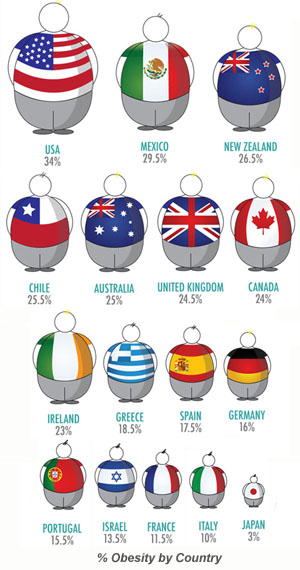
Professor Donal O'Shea is synonymous with the fight against obesity in Ireland and paints a dim picture of where this country is heading, ''Nationally we are losing the battle, we are not reacting to it, either personally or as a society. You only have to look to the States and see where they are, it's not a pretty vista ahead'' (see gif below).
Obesity is now recognised as a ‘global epidemic’ by the World Health Organization (National Taskforce on Obesity, 2005). Along with adults, children are affected by obesity and in Ireland alone it is estimated that 300,000 children are currently overweight or obese (NTO, 2005).

Prof. Donal O'Shea
''It's now unusual to be of normal weight. It's no longer a ticking time bomb - the bomb has exploded - we're at the bomb site'' (O'Shea, 2012).
The epidemic of childhood obesity has been highlighted as a major health concern for today’s youth. It was reported in 2005 that an estimated 20 million children worldwide under the age of 5 were obese (World Health Organisation). The suspected causes of obesity are complex and include environmental and heritable factors (Crothers, 2009), along with lifestyle choices (Centres for Disease Control and Prevention, 2010).
Research also suggests that genetic factors have a role in obesity. With more than 200 genes being linked as possible contributors to obesity, it is highly relevant to look at obesity from a biological point of view. It has been suggested that some people are just predisposed to become overweight, with the heritability of obesity being high (Hinney, 2010), and also the positive correlation between maternal pre-pregnancy obesity influencing early childhood obesity has  been highlighted (Salsberry & Reagan, 2005).

As the obesity number in Ireland nears 1 million, it is clear that we are a country in crisis.

Although research shows that some people with a family history of obesity may be more inclined to gain weight, the recent rapid increase in childhood obesity indicates that lifestyle and not genetic contributions is the primary cause (NTO, 2005).
There's more to life than sitting and eating in front of a television.
 
A lifestyle revolving around the consumption of energy dense foods and a decrease in physical activity creates an environment termed ‘obesogenic’ by the World Health Organization in 1998 (Health Service Executive, 2009). The lifestyle of this environment promotes people to eat too much and exercise too little, creating an energy imbalance which results in weight gain. With a report claiming that children in the United States spend on average 3 hours per day watching television (Committee on Public Communications, 2010), it is possible to see that technological factors could also have a role in promoting an inactive lifestyle. Sedentary behaviours like this are often coupled with eating at the same time (Crothers, 2009). Children spending more time watching television will thus result in less time to engage in physical activities and exercise.
 
The possibility of childhood obesity being determined by Socio Economic Status has been examined as an environmental factor (Stamatakis, 2010). The researchers stated that obesity affects both developed and developing countries alike, but in their study they found that childhood obesity among school children in England had stabilized in recent years, however children from low income households had not benefitted from this trend.

With some of the possible causes being outlined above, what are the health implications for those children affected? The answer is manifold. A result of being overweight can include a lower quality of life (CDC, 2010), an increase in a child’s risk of health problems including; Type-2 diabetes, heart disease, stroke and many types of cancer in later life as well as shortening overall life expectancy (Health Service Executive, 2011).

Regarding obesity in general, Prof. O'Shea remarks, ''With smoking you can point to the heart, point to the lungs, heart attacks, lung cancer and stroke. But with weight related diseases, it's everything; in the brain, your talking about depression, dementia, oesophageal cancer, pancreatic cancer, kidney cancer, heart disease, wear and tear on the hip and knees, right down to your big toe and gout. So everything is made worse by being overweight and it's all remedial''.

You move in a cycle of ups and downs - food adds to the ups and simultaneously creates the downs.
 
Obese children are often the target of stereotypes and discrimination, where being a member of a visibly stigmatised group makes it hard to avoid being prejudiced against. Obesity in childhood not only has health implications but also impacts on the child’s psychological well-being.

Over the last three decades our eating habits have changed dramatically, as the country has been flooded with takeaways, hot deli's and breakfast rolls. If you are any way susceptible to temptation, what hope have you? For many, fast food has become a staple.
 

How America's BMI average has increased ~ CDC
''Parents can't let their children drift the way society is encouraging them to drift'' (O'Shea, 2012). Restrictions on unhealthy food advertising has been suggested as one possible method to prevent children from being influenced by these high calorie foods (Udell & Mehta, 2008), while Carter (2002) suggests a balanced diet consisting of no more than 3 meals per day, fewer high calorie foods and the replacement of sugary drinks like soda, to water.

''Our physical education in schools has failed us . . . it should be focused on health and wellbeing, and sport and activity should only be one part'' (Prof. Niall Moynan, DCU).


'It doesn't matter how slow you go,
you're still lapping everybody on the couch'
Scientific evidence shows that physical activity (PA) helps to maintain a healthy body weight, with people between the ages of 5 to 17 being recommended to accumulate at least 60 minutes of moderate to vigorous intensity PA daily (World Health Organisation, 2011). Physical activity also contributes to the development of healthy bones, muscles and joints, a healthy cardiovascular system and neuromuscular awareness. These benefits demonstrate the role sports and exercise have for overweight children. But common sense also plays a role. Lucozade Sport is great, but to have a five-year-old child drinking 300 calories and only burning off 100 is defeating the purpose entirely.

The further you let yourself go, the longer of a battle it is to get back.
 
Others highlight behavioural changes to help treat obesity (Stewart, Chapple, Hughes, Poustie, & Reilly, 2008). The authors proposed that the use of behavioural change techniques can enhance the motivation of a child by increasing self-awareness of their lifestyle behaviours. Goal setting for changes in diet and physical activity levels, rewards for achieving such goals and the monitoring of diet and low mobile activities (e.g. viewing television), allows the child to monitor progress towards a healthier lifestyle.

''Once you get over a certain weight, people are getting more despairing - you start giving up, nothing is working and they almost give in to the inevitability of more weight gain. There is no magic solution'' (Ruth Yoder - Senior Psychologist at St. Colmcilles Hospital Weight Management Clinic).
 
Parents and caregivers have a responsibility to promote change in their children. They have an immediate impact on shaping their child’s early food environments, attitudes on nutritional information and eating behaviours such as appropriate portion sizes (Anzman, 2010).
 
The global epidemic of childhood obesity is a modern health concern. Research discussed above suggests that childhood obesity is multi-faceted and has numerous and complex variables. One research paper highlighted that some people are possibly just predisposed to be overweight (Hinney, 2010), but with such a rapid increase in those affected by childhood obesity, the lifestyle choices and environmental factors are the more relevant contributors to the problem. People living in a modern day ‘obesogenic’ environment that nurtures weight gain is a considerable problem. Eating too much food, more time spent on sedentary activities, and a lack of health benefitting physical activities like sport, all invariably lead to weight gain. With more unique research proposals on the causes of childhood obesity being related to  socio-economic status, it could be argued that this problem is more than just genetic or diet related.

''At the moment we have a situation where we are sleepwalking into a condition that is killing between 5000 - 6000 people in Ireland every year'' (O'Shea, 2012).
Along with the stigma of carrying excess bodyweight, the health implications of being obese are paramount. In Ireland, 25% of three-year-olds are either overweight or obese. ''The younger you put it on, the bigger you can go'' (O'Shea, 2012). Children should not have to start out life already one step behind in terms of their health.

There are however ways of combatting these problems. By limiting the exposure of certain food advertising (Udell & Mehta, 2008), changing children’s behaviours and cognitions towards their current lifestyle (Stewart, 2008), increasing their time spent with physical activity (WHO, 2011), some simple diet changes (Carter, 2002), and nutritional education from  their primary caregivers (Anzman, 2010), the children and young adults affected by this current epidemic can start to look at its causes as possibly preventable and start to lose weight while adding longevity to their futures.
_____________________________________________________________________________________________________________________

''We're dealing with the kids of 30 years ago, and we're dreading the kids of today in 30 years'' (O'Shea, 2012).